
The Killer Within
Cafe Locked Out Essay 12/03/26

We were in a camp kitchen in Bendigo. I was tired. I can’t recall why, but Steve, a powerful freedom fighter, had a friend he wanted me to interview.
The middle-aged man had three children, all in their twenties, who were vaccine injured.
I suggested I chat to him in the morning, but the man was adamant that he wanted to do it now.
So we sat at a bench-like table, as he offered himself to me, like a clue.
People often talk like the tips of icebergs. If you listen closely, you can see them. If you ask the right question then, the conversation can plunge into their depths.
This was what I was looking for when I listened to this man tell his story.
He had five children. Two to a different woman. All of them had taken the shots, including him, but three of them had developed heart issues so severe they had been implanted with pacemakers. The day before, the third one, his daughter, had just been informed that she too would need a pacemaker.
They had all taken different batches.
When I asked him if he was angry, he shrugged and said, all you can do is deal with the cards you’ve been dealt, and they had been dealt jokers.
I tried a few more times to find the anger that I felt should be there, but I couldn’t find it.
He did tell me that he had been a true believer.
Now, every time he had a shooting pain or a twitch he wondered if this was it. A heart attack, a stroke. Turbo cancer.
But still not a candle’s flame worth of anger.
On a live show once, two jabbed friends of mine, that I’d met through the work, finally met each other via a webcam. Both were known for their humour, but as we all listened in that night, we saw another side.
They didn’t explain why they took it, they instead started asking each other if they felt like they were living with a timebomb in their veins.
This was four years after they had taken it. Both agreed.
One had lain in a forest, on his back as he waited for his heart to stop. He’d never had a heart incident in his life, but here, between the ferns and the gums, and accompanied only by the ants from the nest he was lying on, he accepted that this was where he would die.
He didn’t. He recovered fully and no such incident had happened again, so far.
The other, while waiting in the vaccination centre, with others who had also been jabbed, watched a young boy slide off his chair and as his mother cried for help, the boy started convulsing, and he kept convulsing even as the medical staff tended to him.
“Is he an epileptic,” the doctor asked the distraught mother.
“No,” she said, as the freshly jabbed all looked on and wondered what had they just put in their body?
Or rather, what had the state, the people who they trusted, the experts, convinced or coerced them to put in their bodies.
But never, in either conversation, did I discern what I once would have taken for granted would be an adequate amount of anger.
In Perth I sat in a confessional with a priest, who was originally from Poland, as he confessed to me how he had over one hundred parishioners, who had sat in the seat I was now sitting in, who had confessed to him how they too had been injured by the jabs.
Before coming in here I’d sat through a mass. Most of the prisoners were new Australians, with their families. People who nodded and or smiled at you when they caught you politely studying them.
But these injured people, the Priest had mentioned, refused to go to a hospital or a doctor, for they did not want their new community; the state, to see them as troublemakers, as bad people, as anti-vaxxers.
But they needed to tell someone, so they talked to God, via this unvaccinated priest who was now confessing to me. But he never spoke about any of them being angry.
Just fear, fear of being ostracised.
I was brought up in the church and after I’d finished listening to the priest, I sat in the pews and looked up at the silent cross that hung on the wall behind the altar. Jesus was gone. Perhaps their view of his tortured body was too much for our times.
There was a man there, dressed in black, and wearing a mask. I wasn’t sure if he was another priest, or some helper for the church. Such was the length of time since I’d been to church.
At one point this man left his job of preparing the altar and he came up to me.
I expected that he was going to tell me to put on a mask or leave.
Instead he came in very close and after taking down his mask he whispered, “We are all praying for you. Please keep going.”
Going where? All around me, there were questions, and many of these are still unanswered.
Like, how did most jabbed Australians feel, when Scott Morrison with that perpetual, ‘I’m-cleverer-than-you’ smirk, stated, while being interviewed, ‘no one was forced. It was a choice’.
I remember traveling through Grafton, NSW. It was mid 2022, and a banner that stretched across the main street stated this was ‘a vaccinated town’.
And the funeral directors of two small towns who told me, years apart, how they were burying more people than they ever had. One said, he was up from the regular two a week to seven a week, and how many of the new ones, were young.
I asked the other one if anyone asked her; at these excess funerals, why are so many of us dying?
No, she said. They just stand there silent, then go back to their lives.
Another man, from an even smaller town, had met us in a layby on the outskirts of his hamlet, and told us, as we sat at a concrete kitchen bench, how the last time the town had experienced a stillbirth was ten years ago, yet this month they’d had four.
But there was no vaccination centres being set alight, or doctors or inoculators being chased out of town or worse.
And when we drove through the silent town, all appeared normal.
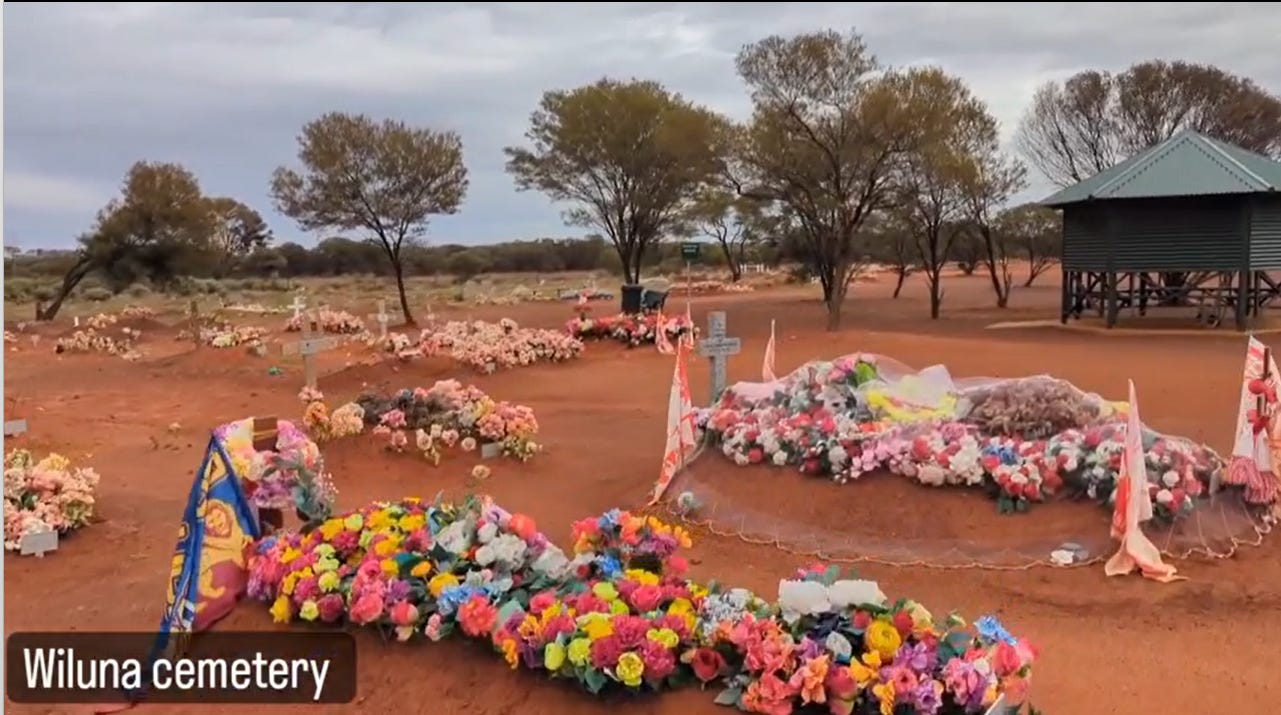
In a remote Aboriginal town we stopped at the cemetery, where the hard sun-cooked earth was decorated in dozens of new graves. Each covered from head to toe in brightly coloured fake flowers.
“It’s the jabs,” a nervous indigenous social worker told me.
They blame the grog and drugs, but this is new. Yet despite the graves, the town was placid and a few of the locals only looked mildly interested in our bus, as they headed to or returned from the town’s only store, an IGA that had all its windows covered in thick metal mesh.
And so the question stayed with me.
As I met other unjabbed folk they asked the same question. Where is the anger? They are injured, they are dying, they are burying their loved ones but still no anger. Why? Are the jabs affecting them? Are they scared because they know it’s in their veins, so they could be next? What?
Then at my sixtieth party, a jabbed relative attended and I wondered how they would go, since many of the people there were outspoken anti-covid-jabs activists, who took it for granted that everyone else there was the same.
Finally, my relative started to speak about how taking it was the regret of her life. I would do anything to go back and choose again. I never wanted to take it but, well work and . . . She didn’t finish.
“Were you injured?” another partygoer asked.
My relative nodded, but then tried to laugh it off and blame it on menopause. But she’d already been through menopause.
Then I told her of an FOI document from New Zealand. It was a memorandum of understanding between the state coroner and the chief medical officer, and in it, the state coroner writes that Covid is not that dangerous, nor that transmissible.
The memorandum was from 2020, from a time before they banned ivermectin and hydroxychloroquine. It was sent before the lockdowns and before the jabs.
But instead of informing the public, they secretly handed out eleven thousand exemptions to the upper echelon, before proceeding to join the worldwide communal fear-filled lies, with the goal of vaccinating as many Kiwis as they could.
Does that make you angry, I asked. Does any of it make you angry? They forced you to take it. They lied, and they are still lying, except the new lies are denial based as they refuse to recognise literally anyone who claims they were injured by the jab.
She shook her head.
“I’m just angry at me,” she said softly.
“I didn’t want to take it and inside me a voice was telling me not to take it, but I did.
Twice.”
She reminded me of an inoculator interviewed who now worked on an avocado farm. “I only ever gave it to one person who wanted it,” she said, “and that was an old woman, everyone else felt like they were being forced.”
Finally she could take it no more and left. But she hadn’t managed to escape, for her eyes were corrupted with guilt, yet oddly, free of anger.
In public, Australians are quieter.
Their larrikinism is largely gone.
They don’t even react, as you expect them to, to all the fear-filled news we wake up to now.
But there was one moment where Australians, enmasse, unleashed their anger.
Around 2023, a family had rescued an injured magpie, but now that it was healed, the state was trying to take it away, stating it was a wild bird, not a pet. And that was against the law.
Yet for some reason this hit a communal nerve.
The outpouring of anger was so intense that politicians and the mainstream media were jumping on board, on the side of the magpie and the family.
That male relative called me up, and after a small chat he moved to the subject of the magpie and then he lost his shit. I had never heard him this angry. Not even during that time in his living room, when that other relative I mentioned informed us all about her vaccine injury, only to be followed by another female relative who also confessed to being injured—instead of hugging and consoling them, instead of raging against the machine, there was just silence. A tense quiet that appeared to be waiting for certain elephants to move back into invisibility. Leaving behind, as they did, the same question that haunts so many of us, now.
Where is the anger?
Michael Gray Griffith
Cafe Locked Out
Michael’s first book of Essays is now int he National Archive /Library.
The symbolic meaning of Jesus drying on the cross because he was mandated to die and his resurrection as a spirit that impacts all who have come after has never had more relevance than when I read this. Trust in the warlords has died and we are now realising that we are more than a useless eater, who needs power, fame and retail therapy. Jesus said "On that day you will realize that I am in my Father, and you are in me, and I am in you." John14:21
I've noticed that many of the jabbed who I know have changed personalities!!! They are both dumbed down and much more placid, accepting of things. I'm sure there is something in the jab;s that caused this change of mood; attitude, personality!!! This could well explain why they have no anger???